
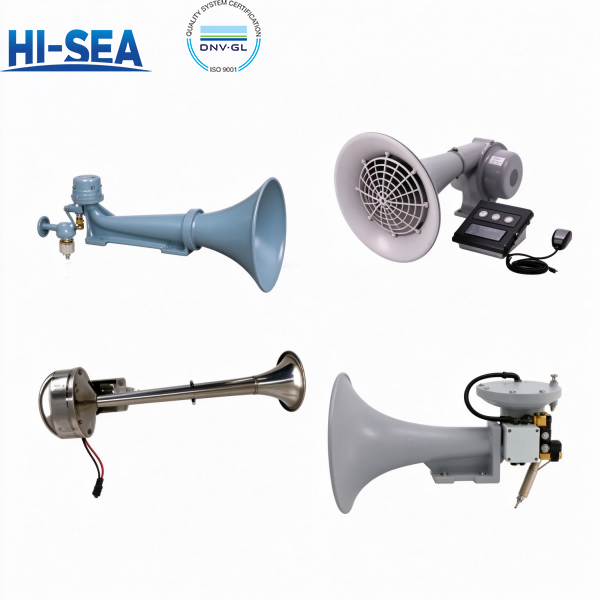
Our marine horns mainly come in two types: the electric horn and the air horn. The electric horn is a fully electrically driven horn that generates sound directly from electric power—saving space, easy to maintain, and energy-efficient and eco-friendly. The air horn, on the other hand, is a combination of air drive and electric control; it is essentially a traditional air horn, but with more automated operation.
Application
According to the Convention on the International Regulations for Preventing Collisions at Sea, 1972 (COLREGs), vessels of 12 metres or more in length shall be provided with a whistle and a bell; vessels of 100 metres or more in length shall, in addition, be provided with a gong. The tone and sound of the gong shall not be confused with that of the bell. The bell, gong, or both may be replaced by other equipment having the same respective sound characteristics, provided that manual sounding of the prescribed signals shall always be possible. Generally, to ensure navigational safety, medium and large vessels are equipped with whistles in two locations: one on the main mast above the wheelhouse, and the other at the bow.
Wheelhouse Main Horn (Air Horn / Compressed Air Horn)
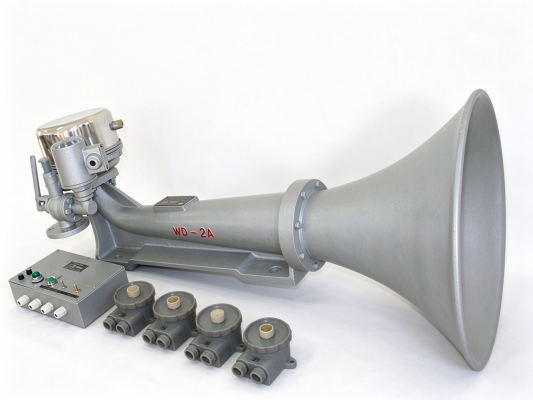
- Power Source: Compressed air (typically supplied by the vessel’s air compressor system, pressure 0.7–1.0 MPa)
- Core Structure: Solenoid valve + pressure regulating valve + vibrating diaphragm + resonance chamber
- Working Process:
① The operator presses the horn button → the solenoid valve opens;
② Compressed air is reduced to 0.3–0.5 MPa via the pressure regulating valve and steadily enters the diaphragm chamber;
③ The airflow strikes the metal/composite diaphragm, causing it to vibrate at high frequency;
④ The vibration is amplified through the trumpet-shaped resonance chamber, producing highly penetrating low-frequency sound waves (typical frequency: 200–500 Hz).
- Features: Fast response, controllable volume, and easy maintenance; suitable for routine communication and collision avoidance signals.
Bow Fog Horn (Electric Horn / Fog Horn / Electrically Driven Diaphragm Horn)
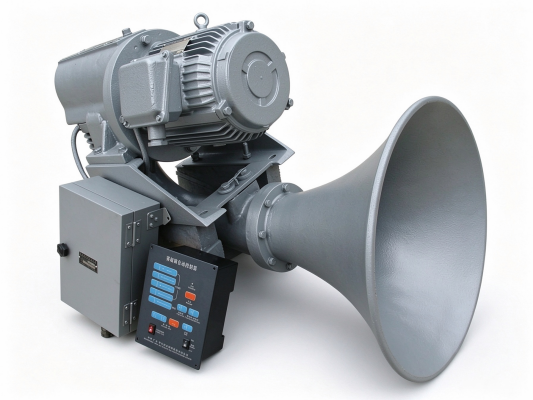
- Power Source: Electric drive (24V DC or 220V AC)
- Core Structure: Motor + reduction gear set + crank-link mechanism + piston-diaphragm resonance chamber
- Working Principle:
The motor drives the crank to rotate → pushing the piston in a reciprocating motion → periodically compressing/releasing the air inside the chamber → forming air-column resonance with the fixed diaphragm → generating high-intensity, low-frequency (approx. 100–250 Hz), continuous and stable sound waves.
- Features: Higher sound pressure level (up to 130 dB or above), strong resistance to wind noise, specifically designed for extreme environments such as dense fog and heavy rain; it is a mandatory safety device under IMO regulations.
- Note: The fog horn cannot replace the main horn for daily use—due to its relatively long startup delay (requiring motor acceleration) and high energy consumption, it should only be activated when visibility is poor.
Codes and Standards——The International Maritime Organization (IMO) sets strict technical requirements for marine whistles:
- Sound Pressure Level: ≥ 130 dB (A-weighted) at 1 meter from the sound source.
- Frequency Range: 180–2,200 Hz for the main whistle, with key energy concentrated in the 250–500 Hz range (the frequency band most sensitive to the human ear and least attenuated by air).
- Duration: A prolonged blast lasts 4–6 seconds; a short blast lasts about 1 second, with an interval of ≥ 1 second.
- Redundancy Requirements: High-risk vessels such as passenger ships and oil tankers must be equipped with dual independent systems (including backup power).
- In addition, different vessel types have exclusive whistle codes:
Towing vessel: One prolonged blast followed by two short blasts.
Vessel not under command: Two prolonged blasts followed by one short blast.
Vessel aground: Three prolonged blasts followed by one short blast.
The characteristic and innovation of electric whistle piston type
1.The piston-type electric fog horn utilizes an electric motor as the prime mover. Through gear transmission, the eccentric shaft rotates at high speed, driving the piston to perform rapid reciprocating motion in the piston cylinder. This compresses the air in the sound-producing chamber, producing the whistle sound.
2.Adopting microcomputer “single-chip” control technology enables human-machine dialogue. It can, according to the actual environmental needs of the ship, automatically and timely emit “fog signals” with different coded information that meet the requirements of international conventions. Its overall implementation achieves automated intelligent control, with cutting-edge technology at a world-leading level.
3.Creatively using “spiral seal lubricating grease technology” ensures not only sealing but also efficient lubrication of major components. This completely overcomes the problems of higher accessory wear and shorter product lifespan found in other similar products, ensuring a lifespan equivalent to that of the ship.
4.The piston cylinder integrates a soft heater made of special materials, ensuring reliable operation, corrosion resistance, rapid heating, controllable temperature, and the ability to work normally in extremely cold environments. The heating source is readily available in daily production activities, making it both environmentally friendly and energy-efficient.
5.Integrating the air compressor, air storage tank, and pipelines completely eliminates the traditional fog horn’s need for high-power air compressors, large-volume air storage tanks, and the various drawbacks of complex pipeline installations. It also has several advantages:
(1) Saves raw materials, significantly reducing manufacturing and operating costs.
(2) Completely solves issues like air leakage in air storage tanks and pipe freezing during use, thereby saving corresponding manpower, material, and financial resources.
(3) Unlike traditional fog horns that require high-power air compression equipment, and even when not sounding the horn, they need to operate frequently to maintain the pressure in the air storage tank, the piston-type electric fog horn does not require air compression equipment. The motor only operates when sounding the horn, reducing energy consumption and eliminating losses in storage, transmission, and conversion processes, making the product more energy-efficient and environmentally friendly.
(4) Maximizes savings in equipment installation space, making ship design more rational and flexible. This is beneficial to various aspects of ship design, manufacturing, and construction, significantly promoting the overall technological level of ships.