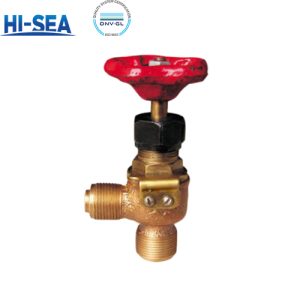
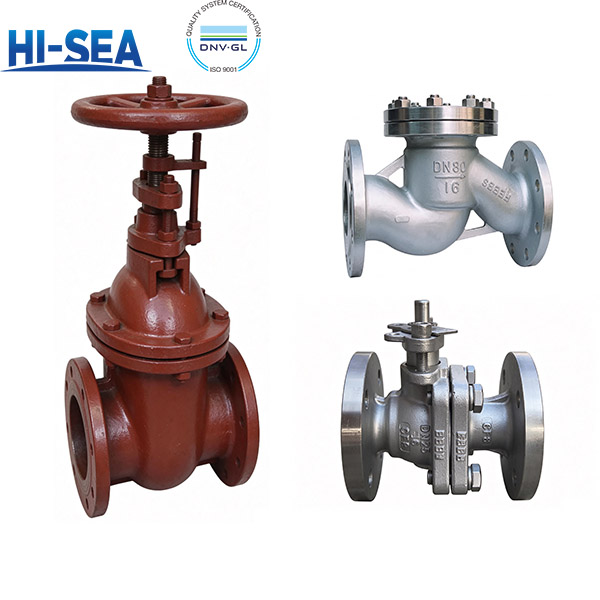
Application
CB marine valves comply with CB/T Chinese marine industry standards, suitable for domestic shipbuilding, ship repair, inland waterway and coastal vessel projects. They are used in ballast, bilge, fire-fighting, cooling and service water piping of coastal ships, inland vessels and marine auxiliary machinery, to isolate and control seawater, fresh water, fuel oil and lube oil, and meet the survey requirements of CCS, DNV, LR, ABS and other classification societies.
Key Materials and Characteristics(For more valve information, please click)
Cast Iron (CB/T 465-1995 Flanged Cast Iron Gate Valves)
Primary Materials: The valve body, bonnet, and valve disc are made of gray cast iron (HT200); the valve stem and nut are made of aluminum bronze (CuAl9Mn2).
Material Characteristics: Gray cast iron offers low cost and excellent castability, making it suitable for low-pressure freshwater, lubricating oil, and fuel oil piping systems. The aluminum bronze stem and nut provide good wear and corrosion resistance when paired with a cast iron body; however, the overall resistance to seawater is limited, rendering it unsuitable for highly corrosive or high-impact operating conditions.
Cast Steel (CB/T 466-1995 Flanged Cast Steel Gate Valves)
Primary Materials: The valve body, bonnet, and valve disc are made of cast steel (ZG230-450); the valve stem is made of stainless steel (2Cr13); the square nut is made of aluminum bronze (QA19-2).
Material Characteristics: ZG230-450 cast steel possesses higher strength than cast iron, allowing it to withstand greater pressures (up to 1.0 MPa) and a certain degree of impact. It is suitable for fuel oil, freshwater, and lubricating oil systems. The 2Cr13 stainless steel stem offers moderate corrosion resistance, while the aluminum bronze nut helps minimize the risk of galling (seizing).
Bronze (CB/T 467-1995 Flanged Bronze Gate Valves)
Primary Materials: The valve body, bonnet, and valve disc are made of cast tin bronze (ZCuSn10Zn2—sometimes also specified as ZCuSn5Pb5Zn5); the valve stem is made of stainless steel (2Cr13); the square nut is made of aluminum bronze (QA19-2).
Material Characteristics: Cast tin bronze exhibits excellent corrosion resistance in seawater, freshwater, and oil-based media, making it one of the most classic materials for valve bodies in marine seawater systems. When combined with a stainless steel stem, it offers superior overall corrosion resistance and sealing reliability compared to cast iron valves, albeit at a higher cost. Stainless Steel Series (CB/T 3955-2004: Flanged Stainless Steel Gate Valves)
Primary Materials: The valve body, bonnet, disc, stem, and fasteners are all made of stainless steel; packing and gaskets are made of PTFE (polytetrafluoroethylene).
Material Characteristics: Suitable for seawater, freshwater, lubricating oil, fuel oil, and corrosive media at temperatures as low as -165°C. The all-stainless-steel construction offers superior performance in salt-spray and corrosive environments, while PTFE seals further enhance chemical stability. This category represents the highest cost among the four material types.
Oil Tanker Series (CB/T 3591-2005: Flanged Gate Valves for Oil Tankers)
Primary Materials: The body and bonnet are made of ductile iron (QT400-15) or cast steel; the disc is made of cast steel (ZG230-450); the stem and nut are made of aluminum bronze (CuAl9Mn2); and the sealing rings are made of stainless steel (2Cr13 / 1Cr18Ni9Ti).
Material Characteristics: Ductile iron offers better toughness and strength than gray cast iron. When combined with stainless steel sealing rings, it ensures both structural integrity and sealing durability under the specific operating conditions found on oil tankers. The use of aluminum bronze for the stem nut follows the standard design practice for marine valves to prevent galling (seizing).
High-Pressure Ball Valves (CB/T 3191-2013)
Primary Materials: Valve body connectors are made of aluminum bronze or carbon steel; the ball and stem are made of aluminum bronze or stainless steel.
Material Characteristics: Designed for high-pressure media (PN 6.4–32.0 MPa), such as air, carbon dioxide, and hydraulic oil. Aluminum bronze components provide corrosion and wear resistance, while carbon steel components meet requirements for higher structural strength. The specific combination of materials depends on the pressure rating and the corrosivity of the medium.
Main Reference Standards
| Main Valve Types | Corresponding to the CB standards | Main Parameters/Description |
| Gate Valve | CB/T 465-1995 | Flange cast iron gate valve, A/AS Type, PN0.25-0.6 MPa |
| CB/T 466-1995 | Flange cast steel gate valve, PN0.25-1.0 MPa | |
| CB/T 467-1995 | Flange bronze gate valve, suitable for seawater, freshwater and oil | |
| CB/T 3955-2004 | Flange Stainless Steel Gate Valve, for liquefied gas carriers, bulk chemical carriers and ships with a nominal pressure not exceeding 0.6 MPa and a design temperature not lower than -165℃ | |
| CB/T 3591-2005 | Flange oil tanker gate valve, A/B/AS/BS type, ductile iron valve body | |
|
Ball Valve |
CB/T 3191-2013 | Manual high-pressure ball valve, types A/B/C/D, PN6.4 – 32.0 MPa, DN10 – 80 |
| CB/T4480 | Marine stainless steel ball valve, suitable for freshwater, seawater, oil, air and corrosive liquids such as acids and alkalis with a temperature not exceeding 150°C. | |
| Check Valve | CB/T 3944-2002 | Stainless steel flange check valve, DN32 – DN50 |
| J Series | CB/T 4003~4030-2005 | J-series flange cast steel/ cast iron/ bronze gate valves, stop valves, check valves, ball valves, etc., with a pressure range of 0.5 to 2.0 MPa. |
| Other Special Valves | CB/T 3778-99 | Marine sounding self-closing valve |
| CB/T 3475/3476/3477-1992 | Marine storm valves (bronze/steel castings, vertical/enclosed type) | |
| CB/T 4414-2015 | Marine metal-sealed butterfly valve |
Pressure Test
Pressure testing standard: CB/T 600
Valve body pressure testing: 1.5PN
Seal pressure testing: 1.1PN
Valve Inspection
Visual and Dimensional Inspection
This is the most fundamental stage of inspection, primarily to verify that the physical valve conforms to the drawings and standards.
Visual inspection: The surface of the casting must be free from defects such as porosity, sand holes, cracks or shrinkage cavities that could affect strength or sealing; machined surfaces should be smooth, with no dents or scratches; markings (such as flow direction arrows, material designations and pressure ratings) should be clear and legible.
Dimensional inspection: Verify the structural length (face-to-face/end-to-end), flange outer diameter, bolt hole centre-to-centre distances and hole diameters, flange thickness, nominal bore and connection thread dimensions to ensure full conformity with the customer’s drawings or the classification society’s approved drawings.
Material and physical and chemical testing
Marine environments place high demands on material reliability, particularly in the presence of media such as seawater and fuel oil.
Verification of Material Certificates: Material certificates (e.g. furnace batch number, chemical composition, mechanical properties) must be provided for major pressure-bearing components and key internal parts, such as the valve body, bonnet and stem.
Spectroscopic Analysis (PMI): For valves made of bronze, stainless steel or special alloys, spectroscopic analysis is often carried out on demand or on a batch-by-batch basis to verify that the alloy composition complies with standards (e.g. bronze grade, stainless steel CF8M, etc.).
Operational and Performance Testing
Operational Smoothness: Manually open and close the valve to check whether the handwheel or handle rotates smoothly and without jamming; for check valves, it is necessary to confirm that the disc moves smoothly and can close normally even at an inclined angle (e.g. 16°, as required by CCS).
Torque Check (where applicable): For high-pressure or large-bore valves, spot checks may be carried out to verify that the opening and closing torques comply with specification requirements.
Coating and Marking Inspection
Anti-corrosion coating: The external surfaces of carbon steel or cast iron valve bodies are typically sandblasted to remove rust (e.g. to Sa2.5 grade) before being coated with anti-rust paint; the paint film should be uniform, with no missed areas or sagging. Bronze or stainless steel valves are generally not coated, retaining their natural metallic finish or undergoing passivation treatment.
Nameplates and Markings: Verify that the information on the nameplates (model, pressure, material, nominal diameter, classification society marks, etc.) is complete and consistent with the actual product.
Review of Factory Documentation
Complete documentation is a prerequisite for on-site inspection by the classification society and final acceptance upon delivery. This typically includes:
Product certificate of conformity/factory inspection report;
Shell and seal test reports;
Material certificates (including chemical composition and mechanical properties);
Dimensional inspection records;
Class society product certificates (e.g. CCS, ABS, DNV, etc., if certification is applied for).