
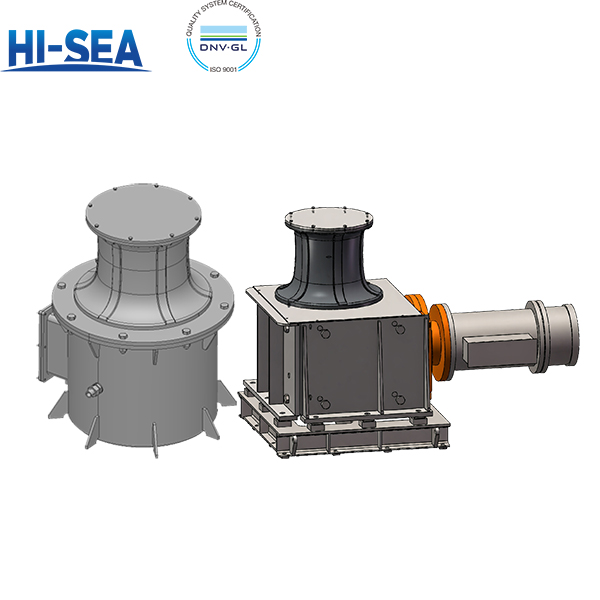
Application
A marine capstan is widely used marine deck machinery, mainly for rope warping and pulling. It relies on friction between the warping head and rope to generate traction. Different from winches, it has no built-in rope storage drum; the rope is hauled and guided manually. It is compact, flexible, and occupies less deck space, widely used for ship mooring, berthing, shifting, auxiliary anchor handling and light towing work. It consists ptakes up less deck space, and is widely used for ship mooring, berthing, shifting, auxiliary anchor handling,rimarily of an electric motor/hydraulic motor, capstan head/warping head, reducer, control system, etc.
HI-SEA Marine supplies marine capstans for cargo ships, tankers, bulk carriers, tugboats, barges, dredgers and workboats. Available in vertical and horizontal configurations, with hydraulic or electric drive, and rated pull from approximately 20 kN to 400 kN (2-40 tonnes). Capstans are supplied with CCS, BV, RINA, and IRS certification where required, together with load test reports and operation manuals for class survey.
Product Classification
✅ By driving type: Electric Capstan, Hydraulic Capstan
✅ By structure: Vertical Capstan, Horizontal Capstan
✅ By use: Mooring Capstan, Mooring anchoring Capstan
✅ Rated pulling force: 5kN ~ 400kN for option
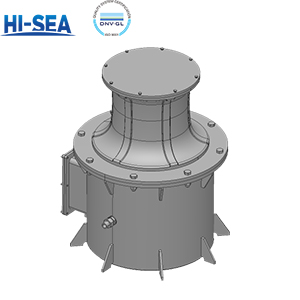 Marine Hydraulic Capstan |
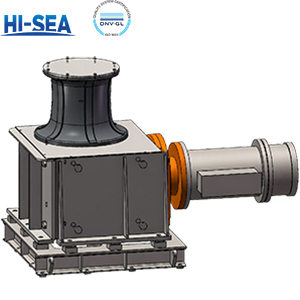 Marine Electric Capstan |
Marine capstans are typically used with wire rope and mooring/fiber rope. For more information, please click the links below:
For mooring rope information, please click here.
For steel wire rope information, please click here.
Hydraulic vs. Electric
Hydraulic capstan: Hydraulic drive offers high torque density in a compact envelope, smooth starting and stopping, and good overload protection. It is preferred where the vessel already has a central hydraulic power pack serving deck machinery, or where the capstan is part of a combined mooring system. Hydraulic capstans are common on larger vessels and on deck machinery packages where hydraulic power is available.
Electric capstan: Electric drive offers simpler installation, lower noise and no hydraulic piping, and is well suited to vessels with adequate deck electrical capacity. Variable-frequency control provides smooth acceleration and precise speed control. Electric capstans are widely used on medium-size cargo ships, workboats and vessels where a standalone hydraulic system is not preferred.
Both drive types can be supplied with local control (foot pedal or lever), overload protection and emergency manual release where required.
Advantages
🔹 Compact layout, small deck footprint, easy installation
🔹 Smooth rope hauling, convenient for frequent short-distance line handling
🔹 Equipped with reliable brake & overload protection, safe operation
🔹 Marine-grade anti-corrosion coating, suitable for long-term saltwater working environment
🔹 Support local control and remote control; VFD speed regulation optional|
🔹 Customizable warping head size, pulling force and mounting form
🔹 Available with class certificates: CCS, BV, RINA, IRS, etc.
Technical Specifications
The table below shows representative ranges. Custom drum diameters, pull ratings and drive configurations are available on request.
| Parameter | Specification Range |
| Rated Pull | 20–400 kN (approx. 2–40 t) |
| Drive Type | Hydraulic / Electric |
| Configuration | Vertical / Horizontal |
| Drum Diameter | Matched to rope diameter and required pull |
| Nominal Speed | Typically 10–20 m/min, depending on duty |
| Rope Diameter | Fibre rope or wire, per vessel mooring arrangement |
| Control | Local control, remote optional |
| Certificate | CCS / BV / RINA / IRS, as required |
Frequently Asked Questions
Q: What is the difference between Capstan and Winch?
A: A winch stores wire or rope on its drum and can hold a load with a brake. A capstan does not store the line; the rope is led around the drum for several turns and tension is generated by friction. Capstans are used where the line must be hauled or slacked without being spooled onto a drum.
Q: What information do you need to quote a capstan?
A: Please provide: rope diameter and material (fibre or wire), required working load, nominal speed, drive preference (hydraulic or electric), vertical or horizontal configuration, deck space constraints, and the classification society required. With these inputs, we can confirm the drum size, motor torque and documentation scope.
Q: Is a brake required on a capstan?
A: Not always. A capstan relies on friction and the crew holding the line turns; a separate brake is not normally fitted unless the capstan is equipped with a chain wheel arrangement that requires a holding brake.