Applications
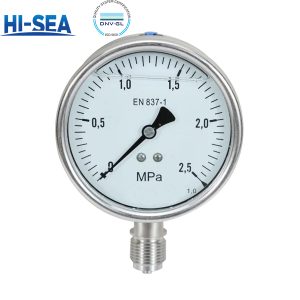
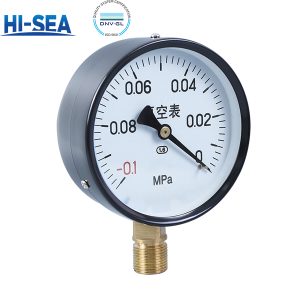
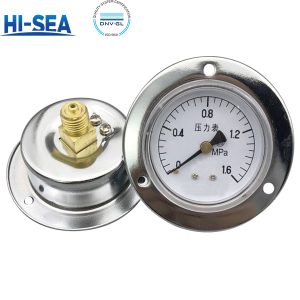
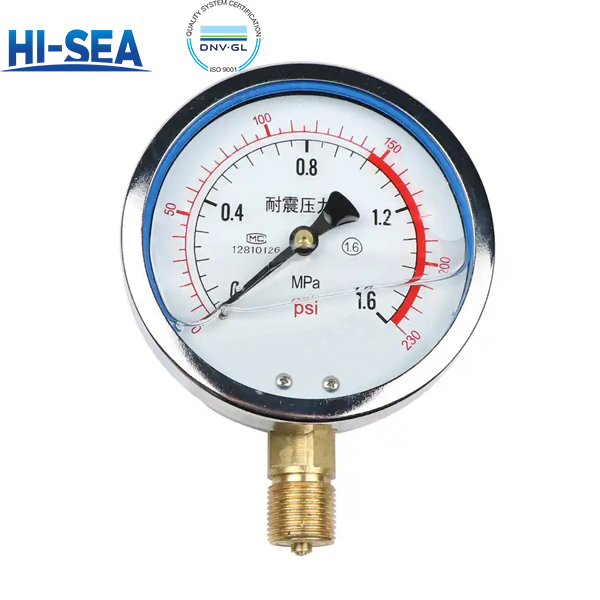
Marine vibration-resistant pressure gauges are measuring instruments specially designed for harsh environments with severe vibration and rocking, such as ships and offshore platforms. Their core design ensures stable and accurate pressure indication under dynamic conditions.
They are mainly used in ships, offshore platforms, and related marine engineering environments. Their design enables reliable operation in the following scenarios:
。Key shipboard equipment: Used to monitor the pressure of main engines, auxiliary engines, pumps, compressors, hydraulic systems, and other equipment in engine rooms.
。Resistance to complex operating conditions: Suitable for measurement points with strong mechanical vibration and severe pressure pulsation, such as pipelines near reciprocating machinery or hydraulic pulsation sources.
。Adaptation to the marine environment: Able to withstand continuous rolling during ship operation (e.g., ±22.5° roll), listing, and salt-spray corrosion.
。Measurement of specific media: Used to measure positive pressure, negative pressure, or compound pressure of liquid or gas media that are non-explosive, non-crystallizing, non-solidifying, and non-corrosive to the instrument’s wetted parts.
Optional Materials
To cope with corrosion in the marine environment and the chemical characteristics of different media, the wetted parts (such as the Bourdon tube and connection) and the case of marine vibration-resistant pressure gauges are available in various materials.
| Component | Optional Material | Application and Characteristics |
| Wetted parts (Bourdon tube/connection) | Copper alloy (brass/bronze) | Suitable for non-corrosive media (such as air, water, and oil); a lower-cost conventional option. |
| – | Stainless steel 304 | Good rust resistance; suitable for high-humidity and salt-spray environments and resistant to atmospheric corrosion. |
| – | Stainless steel 316 / 316L | The first choice for marine engineering. Resistant to chloride corrosion caused by seawater and acidic gases; significantly better corrosion resistance than 304. |
| – | Monel alloy | Used for special highly corrosive media such as hydrofluoric acid and brine; excellent performance but relatively high cost. |
| Case | Stainless steel 304 / 316 | Suitable for coastal, high-humidity, and other rust-prone environments; provides excellent rust protection. |
| – | Cold-rolled steel with powder coating | Suitable for dry, non-corrosive interior cabin environments; lower cost, but maintenance is required to prevent rust. |