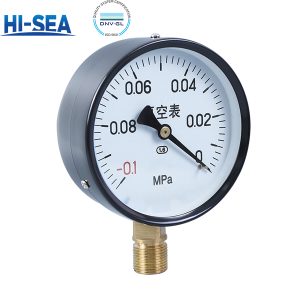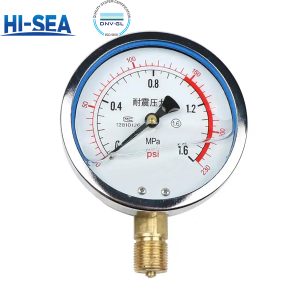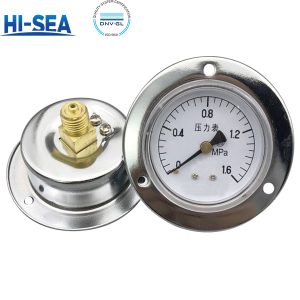
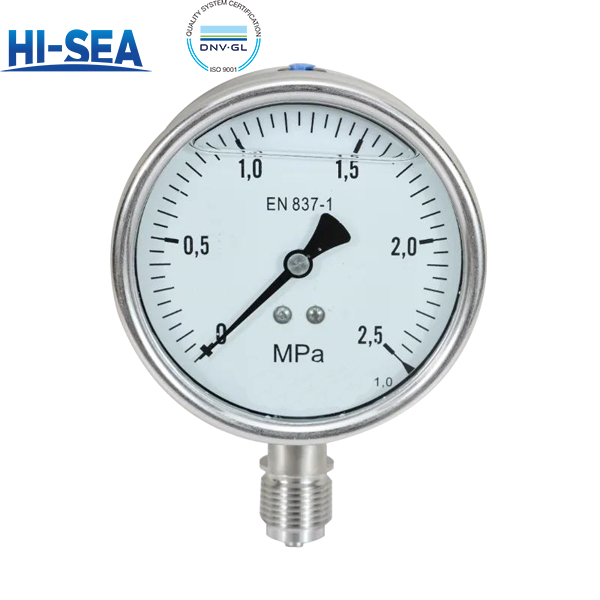
Applications
The applications of YC-type pressure gauges vary by specific model. The main scenarios are as follows:
– Marine and maritime applications: This is the most typical application of the “YC” series. It is specially designed for ships and related equipment to measure the pressure of gases or liquids that do not corrode copper alloys, do not crystallize, and do not precipitate. It can withstand the mechanical vibration commonly found in marine environments.
– General industrial processes: Standard YC-type pressure gauges are widely used in petroleum, chemical, chemical fiber, metallurgy, power station, and other industrial sectors. They are used to measure the pressure of liquids, steam, and gases that are non-explosive, non-crystallizing, non-solidifying, and non-corrosive to copper alloys.
– Measurement of special media (diaphragm type): When measuring highly corrosive, high-temperature, high-viscosity, easily crystallizing media or media containing solid particles, the YC diaphragm pressure gauge uses an isolator to prevent the medium from directly contacting the internal parts of the instrument. It is suitable for processes in petroleum, chemical, pharmaceutical, food, and other industries that have hygiene or corrosion protection requirements.
Key Features
1. Good vibration resistance: This is one of the most prominent features of the YC marine series, enabling stable operation under the severe mechanical vibration conditions found on ships. Some models can also be filled with silicone oil or glycerin (liquid-filled vibration-resistant type) to further offset vibration-induced errors.
2. High visibility and safety: The main scale markings on the dial and the front end of the pointer of many YC marine pressure gauges are coated with permanent luminous paint, making readings easier in dimly lit cabin environments.
3. Precise structure and good stability: A Bourdon tube is used as the pressure-sensing element, and the displacement is amplified through a gear transmission mechanism to indicate pressure. The overall structure is rationally designed, providing high measurement accuracy and long-term stability.
4. Diverse types and strong adaptability: In addition to the standard type, there are also stainless steel models (enhanced corrosion resistance), diaphragm models (for extreme media), and liquid-filled vibration-resistant models, meeting a wide range of needs from conventional industrial applications to special processes.
Standard 1: JB/T 5527-2005 (Machinery Industry Standard for Marine Pressure Gauges)
| Nominal Diameter (mm) | Basic Model (YC) | Shock-Resistant Model (YCN) | Accuracy Class | Main Pressure Range (MPa) |
| Ø50 | YC-50 and variants (T/Z/TQ/ZQ/U) | YCN-50 and variants | ±2.5% | Positive pressure: 0~0.16 to 0~60; vacuum/negative pressure: -0.1~0 to -0.1~2.4 |
| Ø60 | YC-60 and variants | YCN-60 and variants | ±2.5% | Positive pressure: 0~0.16 to 0~60 (some sources state below 25 MPa); vacuum/negative pressure: -0.1~0 to -0.1~2.4 |
| Ø75 | YC-75 and variants | YCN-75 and variants | ±2.5% | Positive pressure: 0~0.16 to 0~60; vacuum/negative pressure: -0.1~0 to -0.1~2.4 |
| Ø100 | YC-100 and variants | YCN-100 and variants | ±1.6% | Positive pressure: 0~0.16 to 0~100; vacuum/negative pressure: -0.1~0 to -0.1~2.4 |
| Ø150 | YC-150 and variants | YCN-150 and variants | ±1.6% | Positive pressure: 0~0.16 to 0~100; vacuum/negative pressure: -0.1~0 to -0.1~2.4 |