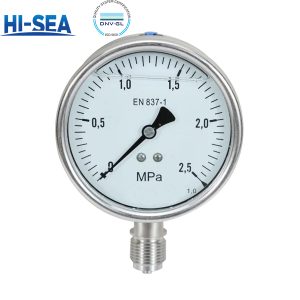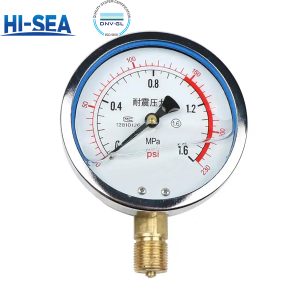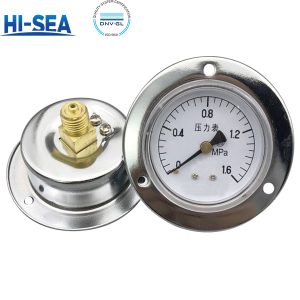
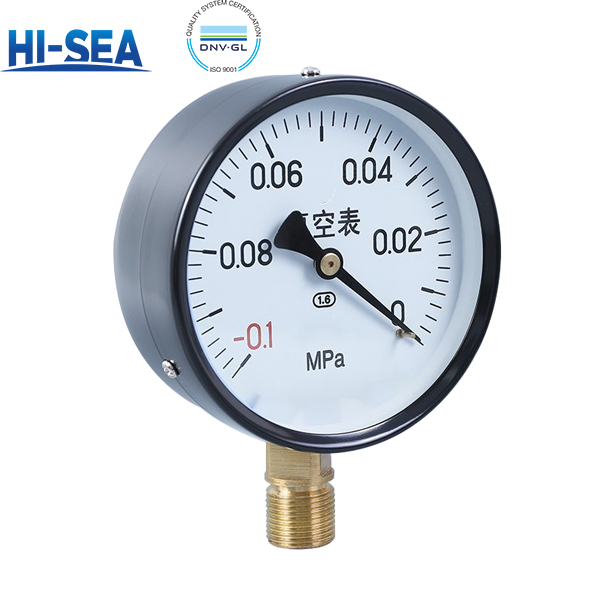
Applications
It is mainly used to measure the pressure or vacuum of liquid, gas, or steam media that are non-corrosive to steel, copper, and copper alloys, and that are non-explosive, non-crystallizing, and non-solidifying. It is widely used in the following scenarios:
. Industrial process monitoring: detecting the pressure status of media in gas transportation, pipeline liquids, and closed containers.
. Specific industry applications: commonly used for safety monitoring in heating networks, oil and gas transmission, machinery, petroleum, chemical, metallurgy, power, shipbuilding, and other fields.
. Special working conditions: shock-resistant pressure vacuum gauges are specially used in locations with severe environmental vibration or pulsating medium pressure to ensure stable readings.
Optional Materials
Material selection for pressure vacuum gauges is mainly divided into two categories: housing and elastic element (media-contacting part), to adapt to different environmental and medium requirements.
| Component | Optional Material |
| Housing material | Plastic case, iron case (painted/chrome-plated), carbon steel case (baked enamel), SUS304 stainless steel, cast aluminum case |
| Elastic element/connection | Phosphor bronze, beryllium bronze, stainless steel SUS304, stainless steel SUS316/316L |
|
Special types |
All-stainless-steel type: made entirely of stainless steel for stronger corrosion resistance; Diaphragm type: uses a stainless steel diaphragm, suitable for easily clogged and highly corrosive media. |