Main Applications
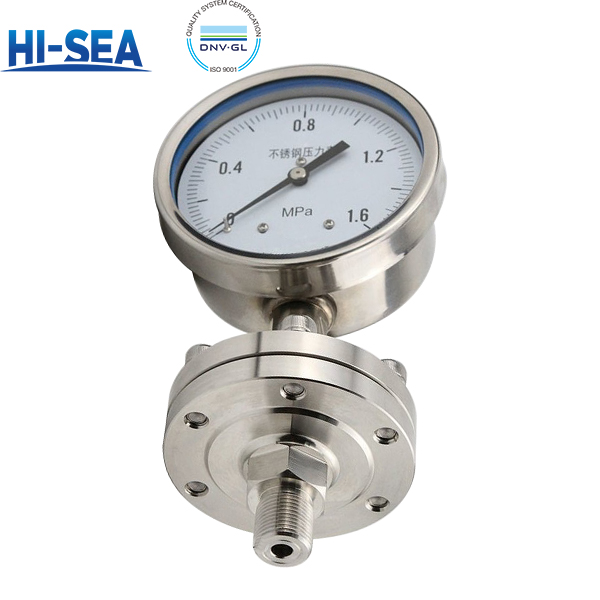
The core purpose of a diaphragm sealed pressure gauge is to protect the pressure instrument from damage caused by harsh or special media. It is suitable for the following scenarios:
. Corrosive media: Measuring fluids such as acids and alkalis that would corrode ordinary Bourdon tubes or connections.
. High-viscosity or easily solidifying media: Such as slurries, glues, asphalt, etc., which may block ordinary pressure gauges.
. Easily crystallizing media: Preventing crystallization inside the instrument that could cause measurement failure.
. Sanitary applications: In the pharmaceutical and food and beverage industries, sanitary designs (e.g., clamp connections) facilitate CIP (Clean-in-Place) and SIP (Sterilize-in-Place) and ensure no contamination.
. Toxic or environmentally hazardous media: Preventing leakage through isolation to protect personnel and the environment.
. High-temperature or low-temperature media: The filling fluid can provide a certain thermal insulation or temperature transmission buffering effect.
Typical Dimensions
Dial diameter (nominal size):
. Common metric sizes: 63 mm, 100 mm, 150 mm.
. Common imperial sizes: 2.5″ (approx. 63 mm), 4″, 4.5″, 6″.
. Process connections:
. Threads: Common specifications such as G3/8, G1/2, R3/8, R1/2, M20×1.5, 1/4 NPT, 1/2 NPT.
. Flanges: Standards include JIS 10K, GB, HG, etc., with various nominal diameters (e.g., DN25, DN50).
. Sanitary clamps: Standard clamp connections such as 1.5″, 2″.
| Model | Upper limit | Flange standard | D | K | d | f | L | C | B | Material |
| F | 4MPa |
GB2506-2005 |
185 | 145 | 122 | 3 | 18 | 20 | 65 |
SUS304 |
| F1 | 6~10MPa | 165 | 125 | 102 | 3 | 18 | 20 | 50 | ||
| 16~25MPa | 115 | 85 | 68 | 2 | 14 | 18 | 25 |
Measuring Range
The measuring range of diaphragm sealed pressure gauges covers a wide span, from micro-pressure to high pressure, and includes vacuum and compound ranges.
• Micro/low pressure:
◦ 0 ~ 60 kPa (approx. 0.6 bar).
◦ Some models can measure low pressures of 1.6 ~ 40 kPa.
• Conventional pressure (in bar/psi/MPa):
◦ Typical ranges: 0 ~ 1 bar to 0 ~ 25 bar (approx. 0 ~ 15 psi to 0 ~ 360 psi).
◦ Medium and high pressure ranges: Can cover up to 0 ~ 100 bar, and even as high as 700 bar(approx. 70 MPa).
◦ Common series such as 0 ~ 0.1 MPa to 0 ~ 6 MPa, and 0 ~ 10 MPa.
• Vacuum and compound ranges:
◦ Pure vacuum: such as -30 inHg (approx. -1 bar).
◦ Vacuum/pressure compound: such as -1 ~ +5 bar, -1 ~ +9 bar, -30 inHg ~ +30 psi, etc.