Applications
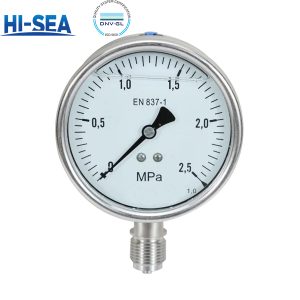
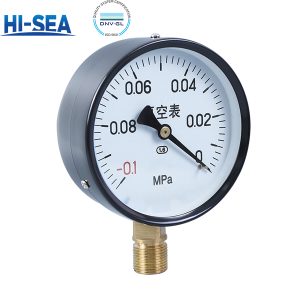
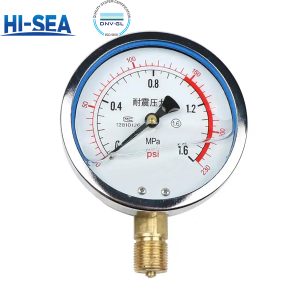
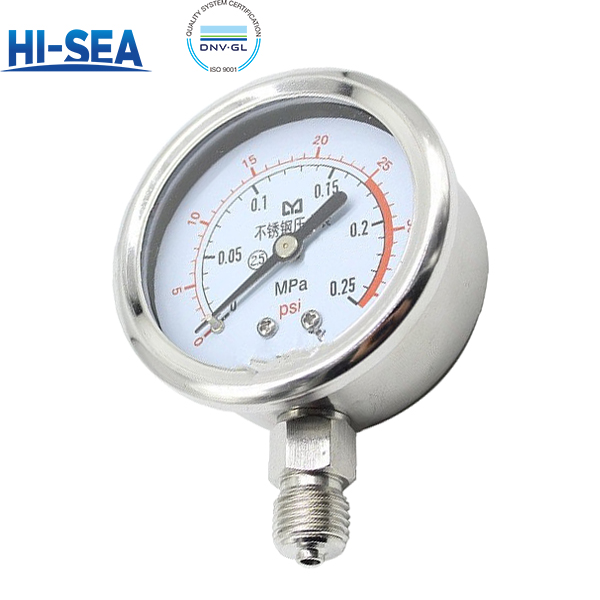
A marine pressure gauge is a pressure-measuring instrument designed specifically for shipboard and offshore engineering environments. Its design focuses on withstanding continuous vibration, salt-spray corrosion, and temperature, humidity variations at sea.
It is mainly used to measure the pressure of gas or liquid media in shipboard installations, where the medium is non-explosive, non-crystallizing, non-solidifying, and non-corrosive to copper alloys (or the specific stainless steel grade used). Typical applications include:
. Ship propulsion and machinery systems: diesel engines, pumps, hydraulic systems.
. Ship piping and compartment systems: ballast water systems, seawater firefighting systems, fuel oil systems, lubricating oil systems, compressed air systems, cooling water systems, sewage systems, etc.
. Offshore platforms and shipping: pressure monitoring on offshore oil and gas fields, drilling platforms, and similar facilities.
Measuring Ranges
Marine pressure gauges cover negative pressure (vacuum), compound pressure-vacuum ranges, and positive pressure. The specific range varies with dial size and accuracy class.
Positive pressure ranges (MPa) commonly include: 0.1, 0.16, 0.25, 0.4, 0.6, 1, 1.6, 2.5, 4, 6, 10, 16, 25, 40, 60. Some high-performance or large-dial models can be extended to 100 MPa, 160 MPa, or even higher (e.g., 1600 bar, approximately 160 MPa).
Negative pressure and compound pressure-vacuum ranges (MPa) include: -0.1 to 0 (pure vacuum), as well as compound ranges such as -0.1 to 0.06, -0.1 to 0.15, -0.1 to 0.3, -0.1 to 0.5, -0.1 to 0.9, -0.1 to 1.5, and -0.1 to 2.4.
Dimensions
The size of a marine pressure gauge is usually expressed by the nominal diameter of the dial. Common specifications range from compact to large dials:
| Nominal dia.(mm) | Common model examples | Reference application |
| 50 | YC-50 | Piping or instrument panels with limited space |
| 60 | YC-60 / YC-60T / YC-60Z | General compact installation |
| 75 | YC-75 | Available in some shock-resistant stainless steel models |
| 100 | YC-100 / YC-100T / YC-100Z | Common specification for main instrument panels in ship engine rooms |
| 150 | YC-150 / YC-150Z / YC-150ZT | Applications requiring clear readings from a distance |